Pantavisor Architecture
At a high level, Pantavisor is just in charge of two things: container orchestration and communication with the outside world.
Container Orchestration
The software that is running in a Pantavisor-enabled device at a certain moment is called a revision. A revision is composed by a BSP and a number of containers. Pantavisor is able to go from the current running revision to a new revision in a transactional manner.
Revisions, as well as other relevant data, are stored on-disk in the device to make them persistent.
Communication with the Outside World
Pantavisor-enabled devices need to communicate with the outside world to consume new updates, exchange metadata or send logs. Users can achieve this remotely as well as locally.
Customisation
Pantavisor can be set up in different ways, offering multi-level configuration as well as several operational init modes. System behaviour can also be extended through system hooks: executable scripts that Pantavisor runs at well-defined lifecycle points — such as system start, update installation, and platform ready — allowing operators to integrate custom logic into the system lifecycle.
Service Mesh
Containers running in the same revision can communicate with each other through pv-xconnect, Pantavisor's built-in service mesh. It handles service discovery and resource injection (Unix sockets, D-Bus, DRM, Wayland) between containers in a secure and declarative way. See xconnect.
State Machine
To get a very simplified view on how Pantavisor works, you can take a look at its state machine:
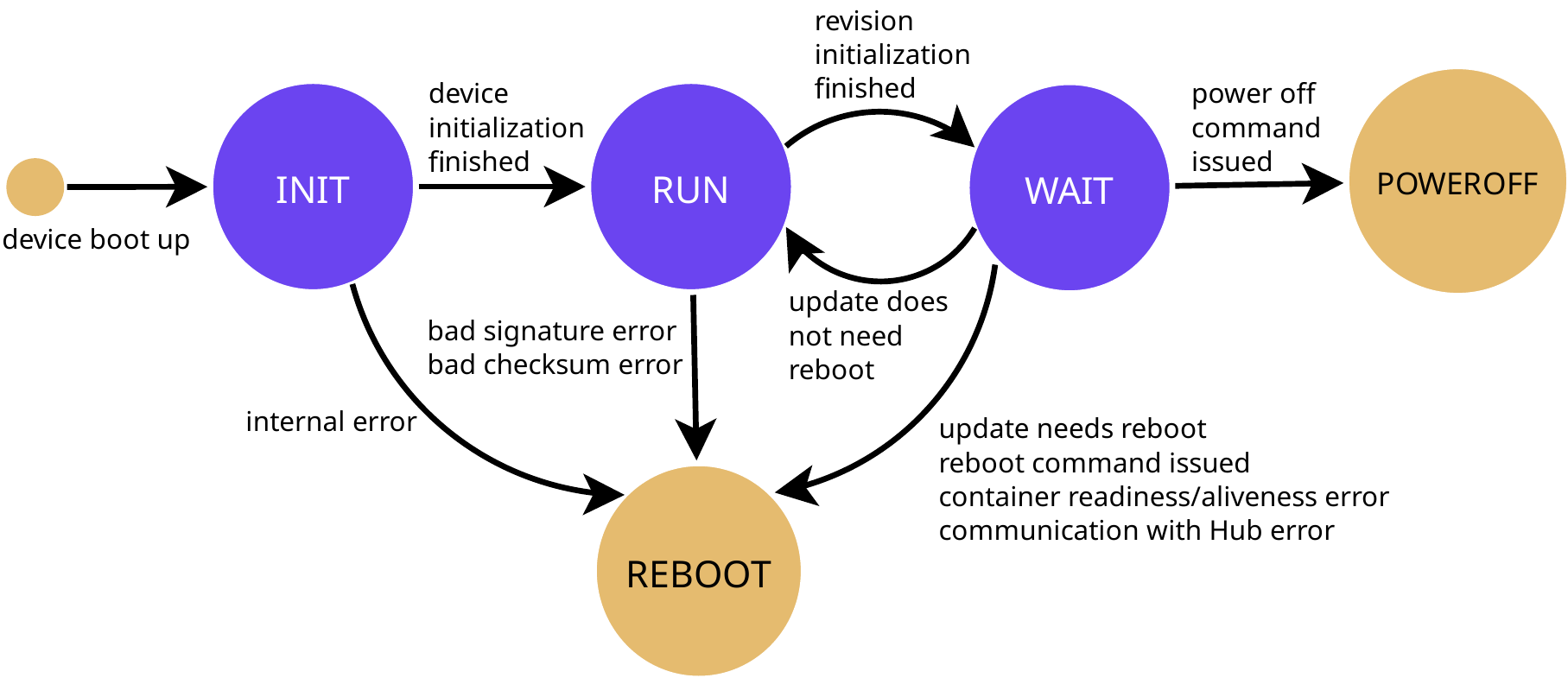
Each state can be summarized as:
- INIT:
- Prepare the base rootfs
- Prepare persistent storage
- Parse configuration
- Choose init mode
- Initialize interaction with bootloader
- Initialize log system
- Initialize control socket
- Initialize watchdog
- Run system-start hooks
- RUN:
- Initialize the running revision
- Check object checksum
- Check revision signatures
- WAIT:
- Start containers and check its statuses
- Run system-done hooks once all containers have met their status goal
- Manage any ongoing update, including installation, verification, transition, etc.
- Run update hooks (
system-before-install-update/system-after-install-updateorsystem-install-update) during update installation - Run system-boot-done hooks after committing a successful try-boot
- Run Pantacor Hub client full state machine
- Process control socket requests
- Manage metadata
- Check and run garbage collector